
by Lanny Peters
Author’s note: During the week before the service, collect a quantity of sizable chunks of rock -- enough for each attending congregant to have one during the service. These need to be more than pebbles. (See if you can find some that are the size of softballs.) Ask your youth to hand these rocks out as worshippers come in for the service. Instruct them to ask the worshippers to hold onto them during the service.
scripture texts:
Genesis 9:8-17
John 7: 53-8:11
sermon
The shadows of the temple walls had grown long. Darkness was coming, and with it the inner call to home and hearth and family. Foxes went to their holes, birds retired to their nests, each person went to his own home, but Jesus went to the Mount of Olives. That night, like many nights, Jesus was a homeless person.
But the next day, Jesus was back. In fact, no sooner had the first rays of the sun peeked over the hillside than Jesus appeared in the Temple again. And the people again were drawn to him, and he sat down and began to teach them.
And as he taught, an excited group of people came into sight, surrounding and pushing a woman in front of them. Several of the religious authorities, easily recognizable in their official garb, were leading the way.
When they reached the spot where Jesus sat, they gave her a little shove which left her standing alone in full view of everybody, as if a trial were about to begin.
Then one of the authorities looked to Jesus and said, “Rabbi, this woman was caught in the very act of committing adultery. Moses has ordered us in the Law to condemn women like this to death by stoning. What have you to say?”
The writer of the story tells us it was a test, that they were looking for something to use against him. Word must have been out that Jesus was on the liberal side of the capital punishment question, that he played a little loose with the religious law sometimes.
If this was true, now they had him cornered. This woman had been caught in the very act of adultery, dragged there straight from her lover’s house, it seems. Jesus would pronounce upon her the judgment of death or else defy the law of Moses.
“Be as wise as a serpent but as harmless as a dove,” Jesus had once warned his disciples, and here was a situation that required exactly that posture. He bent down and started writing on the ground with his finger, giving himself time to take all of this in. Sometimes the better part of wisdom is silence.
Apparently the silence went on long enough to begin making the situation uncomfortable. They had to ask him again. Jesus seemed unperturbed, still bent over and still doodling in the dirt. But as they persisted with the question, Jesus finally looked up and said this: “If there is one of you who has not sinned, let him be the first to throw a stone at her."
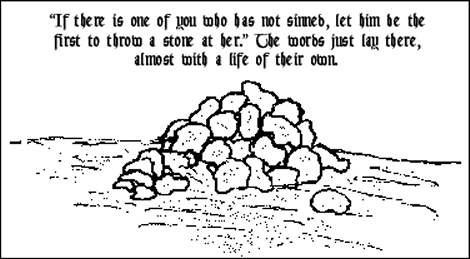
Then he bent down and wrote on the ground again. “If there is one of you who has not sinned, let him be the first to throw a stone at her.” The words just lay there, almost with a life of their own. Suddenly there was not a mob anymore. In its place was a group of people, each an individual, each with his or her own personal history, each with his or her own tragedies and triumphs, and each one now being asked to examine their own lives. Jesus simply requested that one person step out of the faceless mob and be recognized for who they were, and begin the execution.
In doing so, it was almost as if he had silently called each one by name. They had arrived clutching the rocks they picked up along the road. They figured they would need them for sure - if not for the woman, then perhaps for the rabbi. But after Jesus’ calmly spoken words, suddenly their eyes were no longer on the woman, even though she still stood there trembling before them, or even on the rabbi, who had resumed his writing in the sand. Instead, they glanced furtively around at one another.
Eyes met for the first time. “How about you, Eddie?” “Let ‘er rip, Bill, and my rock will be right behind yours.” Several looked expectantly at the Pharisee who had originally spoken for the group, expecting him to break the deadlock. But he was used to ordering executions, not participating in them. So no one moved.
One of the things we humans share in common is our imperfections, our need for forgiveness, our need for grace. It was exactly this that Jesus reminded that crowd.
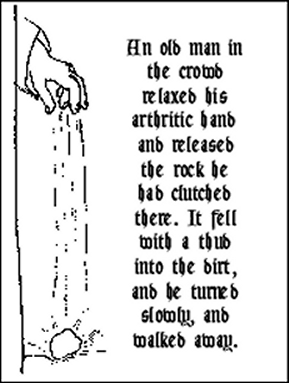 And then, amazingly, perhaps miraculously even, the once bloodthirsty crowd began to look inward, and to examine their own lives just as the gentle rabbi bid them to do. I say that because of what happened next. An old man in the crowd relaxed his arthritic hand and released the rock he had clutched there. It fell with a thud into the dirt, and he turned slowly and walked away.
And then another old woman dropped her stone. And another. Plop. Plop. And then the younger people. And one by one, they dropped the stones they had brought with them and went away, until finally Jesus was left with the woman, who remained standing there.
It seems as though we have just barely gotten through the season of Lent - traditionally a time for Christians to give up something. Many of us, with varying degrees of success, gave up soft drinks, or maybe sweets, or alcohol, or swearing, or television. (Well, maybe not television.) But those are just the tiny pebbles in our lives.
And we tend to forget all about our Lenten disciplines as soon as Easter comes. So we enter into Ordinary Time having given up, perhaps temporarily, the tiny pebbles in our lives. The rocks are harder to give up - and those we should drop permanently. Rocks like revenge. Hatred. The lack of forgiveness. Our biases and bigotries. Our pettiness. Our obsession with materialism. Our fears. But these are just the things on my list; you know which stones your own pockets are lined with.
A former parishioner once told me about a dream that she had. In the dream her sister was drowning while my parishioner stood on the shore throwing rocks at her. “When I awoke from that dream, I admitted to myself how hard I have been on my sister lately. I really have been unhappy with how she is behaving these days. But I began to see that these are tough times in her life. So I decided that even if I did not approve of her actions, she still needs my support, perhaps more than ever. So I have changed my attitude and it has made a difference; we’re feeling a lot closer these days.”
As I listened to her tell me all of this, I heard in her voice a tone of lightness. And why not? She, too, had left some rocks she had long carried lying in the dust.
Jesus offered a new lightness to the crowd who faced him that day, long ago. He taught them that repentance is possible because of God’s great mercy. Karl Barth once said, “You do not repent and find mercy. You discover mercy and that enables you to repent.” Jesus refused to condemn the woman. He also did not condemn the crowd. He refused even to hate the haters.
When Jesus finally put down his stick and looked up, the woman remained standing there. He said to her, “Where are they? Has no one condemned you?”
“No one, sir,” she replied.
“Neither do I condemn you,” said Jesus. “Go away, and don’t sin any more.”
In other words, do not let this moment of grace become cheap grace. You, too, carry some stones. Leave them here with the rest. Leave them here with me.
And so his voice rings out across the years, bidding us to lay down our stones at the foot of the cross and be reconciled - reconciled to ourselves, reconciled to our neighbor, reconciled even to our enemy.
As we look at the life of the church, our community of faith, Jesus once again invites us to empty our pockets of these stones we hold - these things that keep us from being the church for each other. He invites us to into community without these rocks weighing us down.
rock ceremony
Author’s note: At this time in the service, invite the congregation to begin a time of reflection. Ask them to hold their rocks in their hands and meditate on what these rocks represent. Is it anger? resentment? Is it an unresolved issue in your life? After a few moments, invite the ones who are ready to come to the altar and place their rocks on it. After everyone has had the opportunity to do this, tell them that this altar of rocks will remain in the sanctuary for several weeks, and that they may want to bring their rock at a later time. (One of my parishioners told me, sometime after this service, that his rock was sitting on his dresser as a reminder of what he was learning to let go.)
--Lanny Peters is a pastor in Decatur, Georgia.
--Art by Sharon Rollins